A haircut is easy to ask for and hard to undo. Before you sit in the chair, it helps to know what a cut tends to do to the proportions of your face: whether it adds length or width, softens an angle or draws attention to one. That is the idea behind choosing a hairstyle by face shape. It is a way to narrow the field, not a rule that tells you what you may wear.
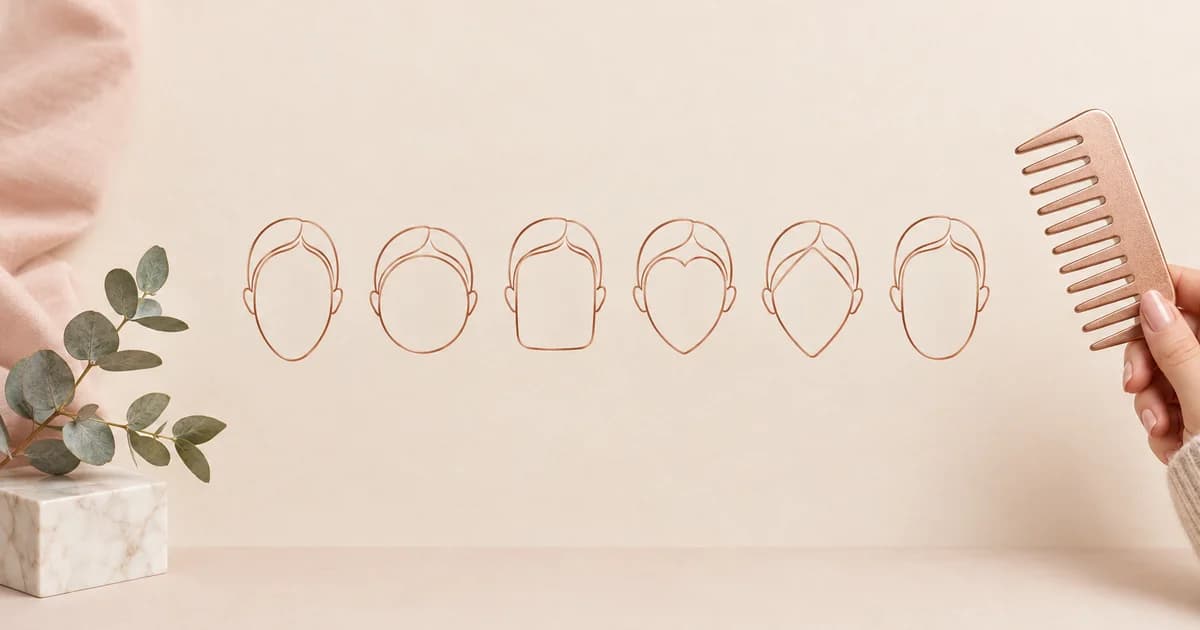
This guide covers six shapes: oval, round, square, heart, diamond and oblong. For each, it says what the shape looks like, which cuts tend to work, which ones need more thought, and where to see a style on your own photo before you decide. It is for anyone, and each shape has suggestions for longer styles as well as short cuts often asked for at a barber.
Quick answer
- Oval: the most balanced shape, so most cuts work. Choose by the look you want, and avoid hiding your face behind heavy fringe.
- Round: add length and angles. Styles with height on top, side parts and cuts that end below the chin tend to help.
- Square: soften the jaw. Waves, layers and side-swept lines tend to help, and a blunt line that stops at the jaw tends not to.
- Heart: balance a wider forehead with fullness at the chin. Layers that start at the jaw and a side-swept fringe tend to help.
- Diamond: keep the cheekbones from being the widest point. Fullness at the forehead and the jaw tends to help.
- Oblong: add width and shorten the look of the length. Fringe, waves and volume at the sides tend to help.
Not sure which one you are? The face shape quiz asks five questions and needs no photo. Then see any style on yourself in the virtual hairstyle try-on.
Find your face shape
Pull your hair back, stand in front of a mirror in even light, and look straight ahead. Then ask yourself four questions:
- How long is my face compared with its width? Clearly longer, a little longer, or about the same.
- Where is my face widest? The forehead, the cheekbones, the jaw, or about the same all the way down.
- What is my jaw like? Angular, softly rounded, or narrow and tapering.
- What is my chin like? Flat or squared, rounded, or pointed.
Then match your answers to a shape:
| If your face is... | The shape is probably... |
|---|---|
| A little longer than wide, with a soft jaw | Oval |
| About as long as wide, with a soft jaw and wide cheeks | Round |
| About as long as wide, with an angular jaw and a flat chin | Square |
| Widest at the forehead, with a pointed chin | Heart |
| Widest at the cheekbones, with a narrow forehead and jaw | Diamond |
| Clearly longer than wide, with a long jaw and forehead | Oblong |
If you would rather measure than judge by eye, compare three widths on a straight-on photo: across the forehead, across the cheekbones and across the jaw. The widest of the three, and how close the other two come to it, points to the shape. Then compare the length of the face with the widest width.
Most faces sit between two shapes. If that is you, read both sections and take what fits. The quiz says so when two shapes fit about equally, instead of forcing a single answer.
Best hairstyles and haircuts by face shape
Each shape below lists styles to try first, and each one links to a preview of that style on your own photo. The styles are suggestions to start from, not a ranked list of the right answers.
Oval face
An oval face is a little longer than it is wide, widest at the cheekbones, with a jaw that curves softly. Few cuts work against it, so the choice is mostly about what you want from your hair.
- Try first: a lob keeps the balance you already have, and body waves add movement without changing the proportions. For a short cut, a side part or a classic taper shows off the whole face.
- Approach with care: very heavy fringe and styles piled high at the crown. Both can make the face look shorter or longer than it is.
Our longer oval face guide goes into detail on lengths and colors.
Round face
A round face is about as wide as it is long, with full cheeks and a soft, curved jaw. The aim is to draw the eye down and add some angles.
- Try first: an asymmetric bob adds a diagonal line, and soft waves that start below the cheeks add length. For short hair, a textured crop with some height on top, or a side part, lengthens the shape.
- Approach with care: a cut that ends exactly at the cheeks, which repeats the roundest part of the face, and a very short, full fringe.
For more on this shape, see our round face guide.
Square face
A square face has a strong jaw with defined corners and a forehead nearly as wide. The aim is to soften the angles without hiding them.
- Try first: loose waves and a layered bob break up the straight lines at the jaw. For short hair, a crew cut shows off a strong jaw, and a textured crop softens the forehead line.
- Approach with care: a blunt cut that stops at the jaw, which draws a straight line across the widest part of the lower face.
Our square face guide has more.
Heart-shaped face
A heart-shaped face is widest at the forehead and narrows to a pointed chin. The aim is to give the lower half of the face a little more width.
- Try first: a lob or a layered bob with layers that start at the jaw adds fullness where the face narrows, and body waves do the same with movement. For short hair, a side part or a textured crop with a fringe breaks up a broad forehead.
- Approach with care: styles with a lot of volume at the crown or the temples, which add width where the face is already widest.
Diamond face
A diamond face is widest at the cheekbones, with a narrower forehead and a narrow, often pointed jaw. The aim is to add width at the forehead and the jaw so that the cheekbones are not the whole story.
- Try first: a layered bob, a lob or a blunt bob adds fullness at the jaw. For short hair, a textured crop with a fringe gives the forehead width, and a side part adds a softer line.
- Approach with care: styles that are tight at the temples and full at cheek level, which stress the widest point.
Oblong face
An oblong face is clearly longer than it is wide, with a long forehead and jaw. The aim is to add width and shorten the look of the length.
- Try first: a layered bob and loose curls add width at the sides, and body waves soften the length. For short hair, a textured crop with a fringe shortens the forehead, and a side part keeps the top from adding height.
- Approach with care: very long, straight styles parted in the middle, which stretch the face further, and cuts with a lot of height on top.
Face shape is a starting point, not a rule
Face shape is one thing to weigh. Several others often matter as much:
- Your hair itself. Texture, thickness, how it grows and where a part falls all change what a cut does. A style that looks lovely in a photo may need daily work on your hair.
- Your hairline. A high forehead, a widow's peak or a cowlick changes where a fringe or a part will fall, whatever your face shape.
- Your features. The length of your nose, the set of your eyes and the size of your ears all interact with a cut.
- Your life. A cut you cannot style on a Tuesday morning is the wrong cut, whatever the shape.
- What you like. Many people break the rules on purpose and look great. If a style on the "approach with care" list is the one you love, preview it anyway.
A good stylist looks at all of this in person and will tell you things a chart cannot, so use these guides to arrive with a few ideas and some pictures.
Preview before you cut
You can see a style on your face before anyone picks up scissors. On Wigwy, you upload a clear, front-facing selfie in even light and choose a style from the catalog of 30 styles, and an AI image model lays it over your photo. The result comes back in about 20 seconds. Style and color change together, so each result is one finished look. Your first try is free with an account, and the free preview carries a watermark. Your selfie is deleted within 24 hours and is not used to train AI models.
Know what a preview is: a ready-made catalog hairstyle laid over your own photo. The catalog is made of wig styles, so what you see is a finished style, not a picture of what your own hair would look like after a cut. It cannot show how your hair's texture, thickness or growth pattern would change the result. Use it to see how a shape and a length sit with your face, then take the pictures to your stylist as a reference.
Try two or three styles from your shape's list on the same photo, and keep the ones you come back to. The try-on tool has the whole catalog.
FAQ
What is the best haircut for my face shape?
There is no single best cut. Each shape has styles that tend to flatter, and they are listed above. Your hair type, your features and what you like count as well, so use the list as a place to start and a stylist to refine it.
What if I fit two face shapes?
Most people do. Read both sections and take the suggestions that overlap. The quiz shows two shapes when they fit about equally.
Does face shape matter for men's haircuts?
Yes, in the same way. A cut changes how the proportions of a face read, and each shape above lists short cuts such as a side part, a textured crop and a classic taper alongside longer styles.
Do bangs suit every face shape?
Not in every form. A long, side-swept fringe tends to suit most shapes, because it adds a diagonal line. A short, blunt fringe tends to shorten the face, which can help an oblong face and work against a round one. If you are unsure, preview a fringe on your photo before you ask for one.
Does the length of a cut change the effect?
Yes. The same style at chin length and at shoulder length can do different things to a face: a cut that stops at the widest part of the face stresses it, while one that ends above or below that point does not. That is why the lists above say where a cut ends as well as what it is.
Can I trust a face shape quiz?
Treat it as a quick self-check. Faces rarely fit one shape exactly, and the quiz is a styling reference, not a measurement or a judgment of how you look.
Will a preview show how a haircut will look on me?
Not exactly. It shows a catalog style laid over your photo, which helps you judge the shape and length against your face. How the cut would look on your own hair depends on its texture and thickness, which a stylist can assess in person.