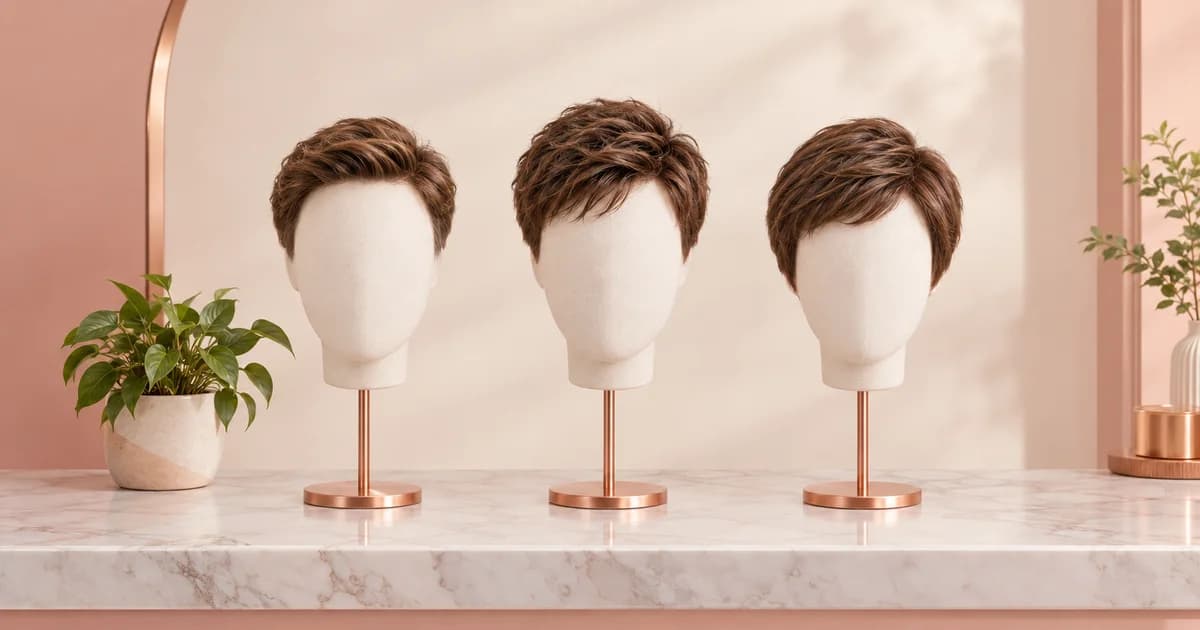

If you are thinking about a hair system, you have probably noticed how hard it is to get a plain answer. Sellers use different words for the same thing, prices are rarely listed, and most photos online are chosen to sell. This guide explains what a hair system is, the kinds of base, what moves the price, what keeping one looks like month after month, and how to see a style on your own face before you ask anyone for a quote.
Quick answer
A hair system is a hairpiece for men, built on a thin base and attached to the area of the head where you want hair. It is usually made to match your own hair in color, density and direction, and it stays on for days or weeks at a time instead of coming off every night. "Toupee" is the older word for much the same thing, and a wig is a piece you put on and take off as a whole.
- The base decides most of the rest. Lace, monofilament and thin polyurethane each trade off how natural the edge looks, how well the piece breathes and how long it lasts.
- The price is not one number. It depends on the base, the hair, how much is made to order and what the upkeep costs over the years, not only the piece itself.
- It is a routine, not a purchase. Systems come off on a schedule to be cleaned, re-attached and eventually replaced.
- You can look before you commit. A preview on your own photo shows a shape and a color, not a hair system on your head.
What a hair system is
A hair system is made of two parts: a base and hair. The base is a thin, flexible layer shaped to the area you want covered, which might be a hairline and the front of the head, the crown, or the whole top. Hair is tied, injected or sewn into the base strand by strand. The finished piece is then cut and styled, and it is attached to your scalp, or to the thin hair around the edge, with tape, adhesive or clips.
Two ideas set it apart from the other options:
- It is made for one head. Many systems are ordered to a template of your head and a sample of your hair, so the color, the density and the hairline can match what you have.
- It stays on. Where a wig is taken off at night, a system is made to stay on between scheduled visits, and how that works day to day depends on how it is attached.
People weigh a system against a wig, a clip-in piece, or doing nothing at all, and our comparison of toupees, hair systems and wigs sets the three side by side. Our page for men shows the men's styles on sample photos, and since several system bases borrow the materials of lace wigs, our comparison of lace front and full lace wigs explains how lace is built.
Types of base
The base is the part you cannot see in a photo and the part that shapes everything you will live with. Four kinds come up most often.
| Base | What it is | Where it tends to be strong | Where it tends to give |
|---|---|---|---|
| Lace (French or Swiss) | A very fine mesh with hair tied into it | A soft, hard-to-see front edge; breathes well | Delicate: it can tear, and it often wears out sooner |
| Monofilament | A fine, slightly stiff mesh | A natural look where the hair parts; comfortable | Less invisible at the edge than lace |
| Thin polyurethane (also called poly or skin) | A thin film that looks like skin | Durable, easy to wipe clean, holds tape well | Warmer, because air does not pass through it |
| Combination | For example a lace front with a polyurethane edge | Spreads the strengths: a soft front and a sturdy perimeter | More parts, so more to ask about |
Two choices come after the base:
- How the hair is put into it. Hair tied by hand to a mesh tends to move more naturally and takes longer to make. Hair injected into a film tends to hold up under daily wear.
- How the base is attached to you. Tape and liquid adhesive are the most common. Clips can be taken off at will. Bonding methods hold longer between visits and are harder to undo. Each method changes how often the piece comes off, and whether you can swim or sweat in it, so ask the seller to name the method that goes with the piece they are quoting.
If your skin reacts to adhesives, tell the specialist before the first fitting and ask for a small patch test. If the skin under a piece ever becomes sore or irritated, take it off and talk to a doctor. A comfort problem is not something to push through.
What affects the price
We do not quote a price here. Prices differ too much between sellers, bases and services for one figure to help, and a figure without its sources would only mislead. What we can do is show you what moves the price, so you can read a quote.
- The base. A fine lace base takes more care to make than a standard film one, and a base made to a template of your head costs more than a stock one.
- The hair. Human hair usually costs more than synthetic, and the closer the color match, including blended gray, the more work it takes.
- Length and density. A short, thin style is quicker to make than a long, dense one.
- The service. A piece sold with fitting, cutting and maintenance visits is priced differently from one you buy on its own and look after yourself.
- How long it lasts. A cheaper piece that has to be replaced twice as often is not cheaper in the end.
When you ask for a quote, ask for it in writing and ask what it covers. A useful quote names the base, the hair, the attachment method, the first fitting, and what each later visit or replacement costs. If a seller cannot say what happens after the first month, take that as information about the seller.
Upkeep and replacement
Owning a hair system comes down to a cycle. You wear it for a period, then it comes off, the base and the skin underneath are cleaned, and it goes back on. Between those visits you wash and style it as the seller advises, which may mean specific shampoos.
What to ask about before you start:
- How often does it come off? Intervals depend on how it is attached and on how much you sweat, and sellers give very different figures.
- Who does it? Some people learn to do it at home. Others book a salon visit each time. That decision is a large part of the real cost.
- How long does a piece last? Providers quote lifespans from a few months to a year or more, depending on the base, the hair and how you wear it. Ask for the figure for the exact piece you are being quoted, not a general range.
- What happens at the edge? The front edge is usually the first part to show wear. Ask whether it can be repaired or whether the piece has to be replaced.
- What changes as your own hair changes? If your own hair keeps thinning, a piece made for last year's hairline may need to be remade.
Keeping a system looking natural is mostly about keeping to the routine. A piece worn past its time, with an edge that has lifted, is often what makes a system look obvious.
Preview a look before you commit
A hair system is a commitment of money and routine, so it helps to know the look you want before a consultation.
On Wigwy, you upload a clear, front-facing selfie and choose a style and a color from the catalog of 30 styles. An AI image model lays that catalog style over your own photo, and the result comes back in about 20 seconds. Style and color are changed together, so each result is one finished look. The men's section has classic cuts such as the side part, the textured crop and the slicked-back look. Your first try is free with an account, and the free preview carries a watermark. Your selfie is deleted within 24 hours and is not used to train AI models. The virtual hairstyle try-on page explains the same steps for any style.
What a preview is not. It is a catalog style laid over your photo. It is not a fitting, and it is not how a hair system will look on your head. It cannot show the base, how the edge blends into your skin, how the piece is attached, how dense it is, or how it looks from above or behind. Use the picture as a shape and a color to talk through, and ask the specialist for photos of pieces they have made and clients are wearing now.
A simple way to use it: try two or three men's styles on the same photo, keep the one or two you keep coming back to, save them as reference pictures for a specialist, and say that they are previews and not photos of systems. Then take the questions from the upkeep list above to the consultation.
FAQ
Is a hair system the same as a toupee?
They overlap, but the words are not used the same way. "Toupee" is the older word and often means a smaller piece for the top of the head. "Hair system" is the modern term for a piece built on a thin base and attached for days or weeks at a time.
Can I sleep, swim or exercise in a hair system?
It depends on how the piece is attached and on what the seller advises, so there is no single answer. Some methods are made to be worn through all three, and others are not. Ask about each activity by name before you buy.
How long does a hair system last?
Sellers quote very different lifespans, from a few months to a year or more. The base, the hair, how it is attached and how you wear it all change the number. Ask for the figure for the exact piece you are quoted, in writing.
Will a preview show me what a hair system will look like on me?
No. A preview shows a catalog style and color over your photo, which can tell you whether a shape suits your face. It cannot show the base, the edge, the attachment or the density, so use it to decide what to ask for, and then ask the specialist to show you real pieces.